02.
JPMORGAN CHASE /
RETHINKING THE BANKER EXPERIENCE FOR DATA-DENSE WORKFLOWS.
ROLE /
UX DESIGN & RESEARCH INTERN
TIMELINE /
10 WKS
PROJECT TYPE /
ENTERPRISE DATA PLATFORM
TOOLS & SKILLS /
FIGMA, USER RESEARCH, WORKSHOP FACILITATION, AI-ASSISTED WORKFLOW
TEAM /
3 UX INTERNS & CROSS-FUNCTIONAL PARTNERS
Reframing a dense stream of client data into prioritized, actionable guidance.
Bankers constantly process massive amounts of client data to identify opportunities. Our challenge was to design a single, cohesive information experience that organizes this data-dense workflow into actionable steps, though specific details remain protected under NDA.
Over a 10-week summer internship in the Firmwide Design Development Program (DDP), I collaborated with two co-interns, alongside product, research, tech, and data partners, to deliver a high-fidelity internal platform prototype.
OUR APPROACH
01
Because enterprise design requires navigating strict domain constraints, our process prioritized structural alignment over immediate wireframing.
Aligning language before designing.
Early research surfaced that core terms meant entirely different things to different teams. We paused to align on definitions before designing anything, ensuring that ambiguity in vocabulary wouldn't become ambiguity in the interface.
Hierarchy as the main design problem.
We were tasked with organizing dense information so that it was immediately actionable. Most of my design effort went into information architecture, deciding what should be surfaced the highest, what became supporting context, and what didn't belong on screen.
Continuous feedback from workshop sessions.
Rather than waiting until prototypes were polished to ask for feedback, we ran working sessions with designers, researchers, product managers, and data partners across the firm. These sessions clarified our assumptions and ensured technical feasibility early on.
Building on shifting ground.
The problem space was still taking shape while we designed. There was no time to wait until technical details or product requirements became certain. We learned to commit to architectural decisions with incomplete information and revisit them deliberately as constraints clarified.
OUTCOME & IMPACT
02
High fidelity screens delivered.
Cross-functional experts facilitated in our workshop session.
Presentations given to VPs, design leads, and product stakeholders.
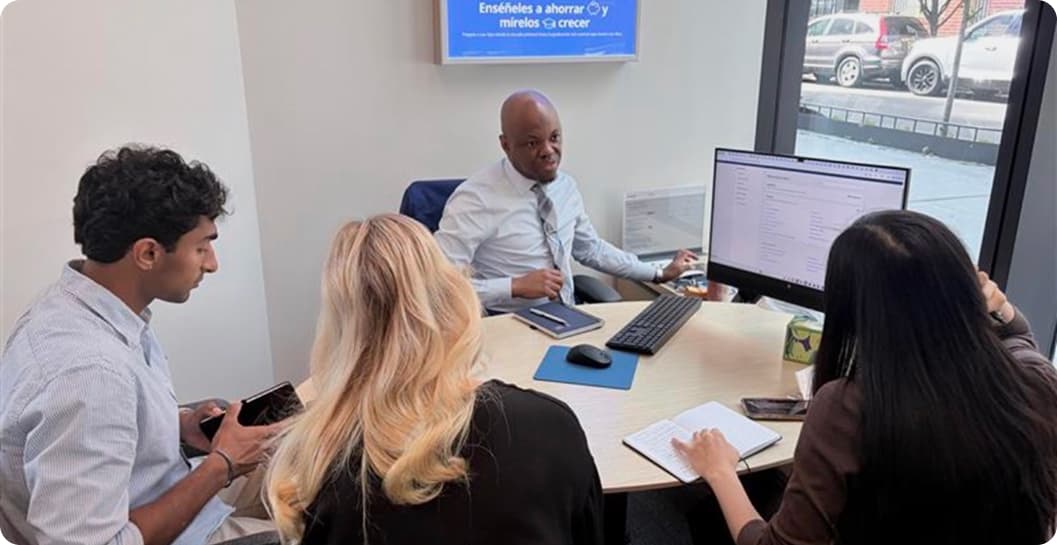
In-branch visit observing bankers in action.
REFLECTIONS
03
Due to NDA restrictions, the final high-fidelity prototypes and proprietary workflows cannot be shown. However, the final deliverable successfully synthesized 10+ research artifacts into a cohesive vision that aligned product, tech, and design on the future of the banker experience.
Takeaways
Facilitation is a core design skill.
For working sessions, we coordinated twenty people from design, product, research, and data into one Zoom call. Making sure we left this session with decisions rather than opinions took as much preparation as the designs themselves. I learned to construct activities that invite all feedback and frame questions narrowly to drive consensus.
Constantly strive to validate assumptions.
It is easy to rely on synthesized data, but there is no substitute for observing the user in their actual environment. Stepping away from Figma and conducting a branch visit to watch how the bankers work was where some of the most critical design decisions were made.
The Team
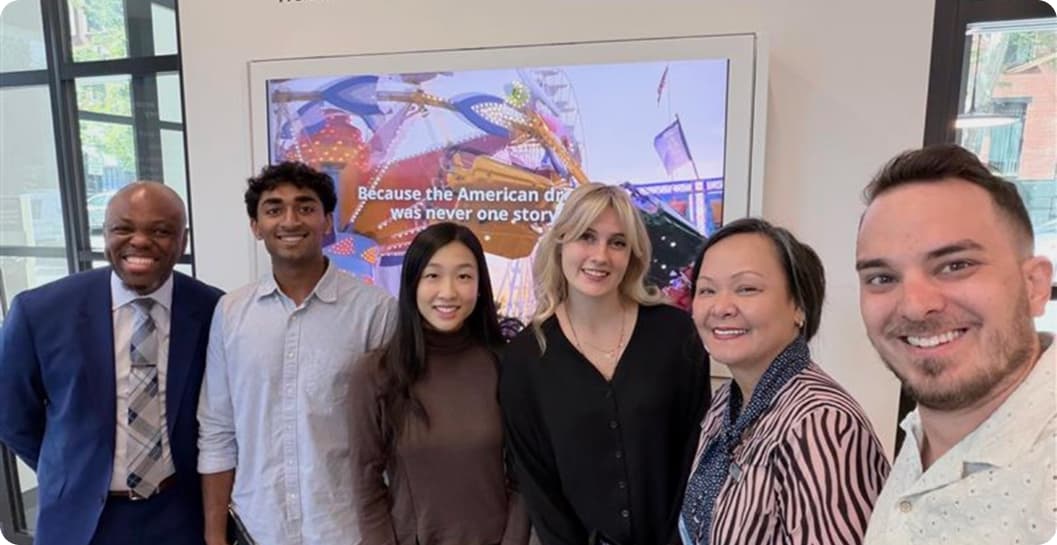
Endlessly grateful for all the amazing people I worked with this summer. Working alongside and learning from my two co-interns, Johanna Lohmus and Karun Natarajan, made the experience so special. Huge thank you as well to my other DDP cohort interns, Yuki and Kayla, and my direct managers, Maria and Antonio, for such a fun summer.